Spain Digital Nomad Visa for Families Explained
- February 12, 2026
- Posted by: Viktor Vincej
- Category: Latest News

Spain’s Digital Nomad Visa, introduced under the 2023 Startup Law, has rapidly positioned the country as one of Europe’s most attractive destinations for remote-working professionals and their families.
While early applicants were predominantly solo entrepreneurs and tech workers, immigration specialists report a steady increase in family-based applications. The Spanish Digital Nomad Visa explicitly allows principal applicants to include immediate family members, provided that defined income and documentation thresholds are met.
The residence authorization is valid for up to one year if obtained through a Spanish consulate abroad, or up to three years when applied for from within Spain. Importantly, family members may be included in the initial application, avoiding the need for a separate reunification process later.
Who Qualifies as a Family Member
Spanish immigration law recognizes spouses or legally registered partners, minor children, and dependent adult children with disabilities as eligible dependents. In certain circumstances, financially dependent parents may also qualify.
Applicants must provide legalized or apostilled civil status documents—such as marriage and birth certificates—along with certified Spanish translations. Incomplete documentation remains one of the primary causes of processing delays.
An immigration attorney in Madrid recently told a national business outlet, “Applicants often focus on income requirements but overlook document formalities. A missing apostille or incorrect translation can significantly delay approval.”
Income Requirements for Families
Financial solvency is central to approval. The main applicant must demonstrate income equivalent to at least 200% of Spain’s monthly minimum wage (SMI). For dependents, the threshold increases by 75% of the SMI for the first additional family member and 25% of the SMI for each subsequent member.
In practical terms, the required monthly income scales according to family size. Authorities typically require employment contracts, freelance agreements, company registration documents, and bank statements proving income stability. At least 80% of income must originate from non-Spanish sources.
Below is an illustrative estimate of minimum gross monthly income requirements based on the current minimum wage framework. Figures are approximate and may change with adjustments to the SMI.
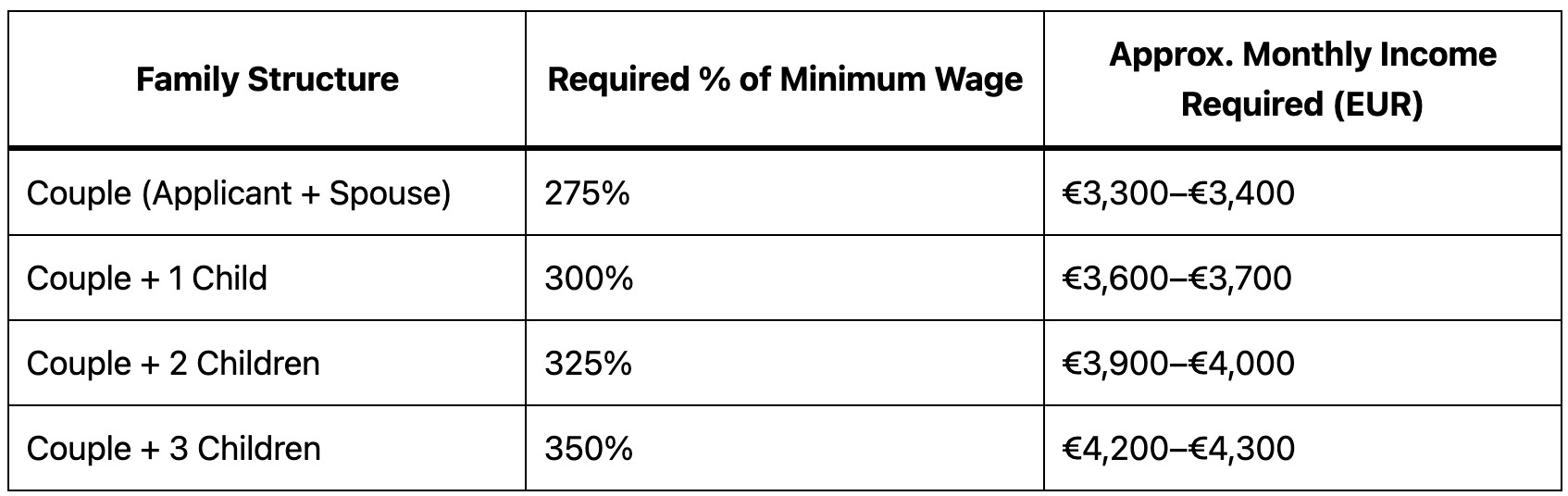
These figures represent minimum eligibility thresholds and do not reflect total living expenses, which vary by city and lifestyle.
Healthcare and Insurance Requirements
All applicants, including dependents, must maintain comprehensive private health insurance issued by a provider authorized in Spain. The policy must offer full coverage without co-payments and be valid for the entire duration of residence.
Proof of coverage must be submitted at the time of application and renewed alongside residency extensions.
Employment Rights for Spouses
One of the distinguishing features of Spain’s framework is that dependent spouses are permitted to work in Spain, either as employees or self-employed professionals. This flexibility distinguishes Spain from certain other European remote-worker schemes that restrict employment rights for family members.
A Barcelona-based relocation consultant noted in a recent interview, “Spain’s policy reflects an understanding of modern dual-income households. Allowing spouses to work enhances long-term settlement viability.”
Education and Family Integration

Families relocating with children must consider Spain’s education system. Public schools are tuition-free but require local registration. Semi-private (concertado) schools receive partial state funding, while international private schools offer foreign curricula at significantly higher tuition costs.
Availability varies by region, and major cities often experience high demand for international placements. Early planning is strongly advised.
Tax Implications for Families
Families residing in Spain for more than 183 days per year generally become Spanish tax residents. Eligible applicants may apply for the special expatriate tax regime, commonly referred to as the “Beckham Law,” which may allow taxation at a flat rate on Spanish-sourced income for a limited period.
However, when both spouses earn income, cross-border tax exposure can become complex. Professional tax advice is recommended to evaluate income tax, wealth tax, and potential treaty protections.
A Structured Pathway for Relocating Families
Spain’s Digital Nomad Visa offers a defined legal pathway for families seeking long-term relocation within the European Union. By combining employment flexibility for spouses, clear income thresholds, and access to healthcare and education systems, Spain has created one of the more family-inclusive digital nomad frameworks in Europe.
As remote work continues to evolve beyond individual freelancers toward globally mobile households, Spain’s approach reflects a broader shift in migration policy—one that increasingly recognizes the economic and social realities of modern international families.